The campaign for a Jäger during the American War of Independence (AWI) was a rugged and unpleasant experience. Omitting any distinctive supply issues that British Forces experienced on the campaign, contemporary accounts note that light infantry, and particularly Jäger, went without luxuries that were commonplace for other units. These accounts often describe an experience such as Ewald’s:
“We had nothing with us but what we carried on our backs, not even a bite of bread.”
— Johan Ewald, Diary of the American War: A Hessian Journal, pg. 161
Unfortunately for our humble unit, in order to portray an accurate representation of the 2nd Anspach-Bayreuth Jäger Company during the AWI, we must also forgo many niceties that other units are able to use. The guiding principles we use to inform our decisions on what to pack for our camp comes from Johann Ewald himself. Reflecting on his experience commanding Jäger Corps during the AWI and Seven Years War, Ewald published the Treatise upon the Duties of Light Troops in 1803. Within the treatise, Ewald comments on his preferences for sustainment in the field:
“…As light troops have no tents, of course officers must not be allowed to have any tent or field bed; a bear skin or deer skin, or a blanket besides a great coat must suffice. No officer in the Hessian and Anspach Jagers, during the American War, ever carried with him any tent, or bed, table or chair, and once used to it we did not dislike this hard way of living…”
— Johann, Ewald, A Treatise Upon the Duties of Light Troops, pg. 29-30

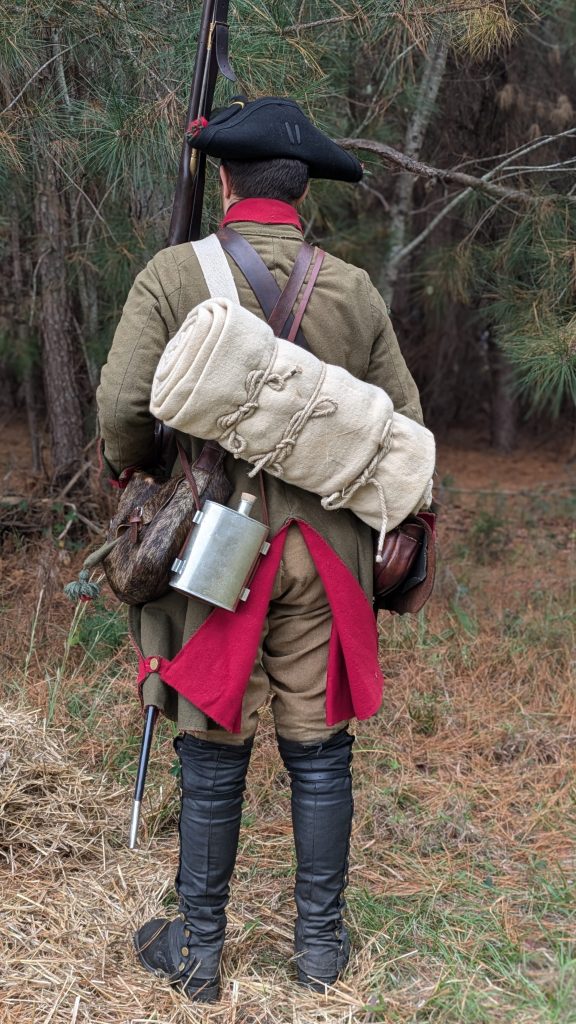
Example of a typical Jäger with all sustainment and equipment for campaigning
Thus, our unit has opted to pack as light as possible for reenactment weekends. Ewald, through his experiences commanding light infantry troops through the AWI, understood that unnecessary baggage is not conducive for a unit responsible for skirmishes and being as swift as possible. As a result, this limitation creates a distinctive experiment for members: Having to determine what one can use for multiple purposes or go without for a typical reenactment weekend.
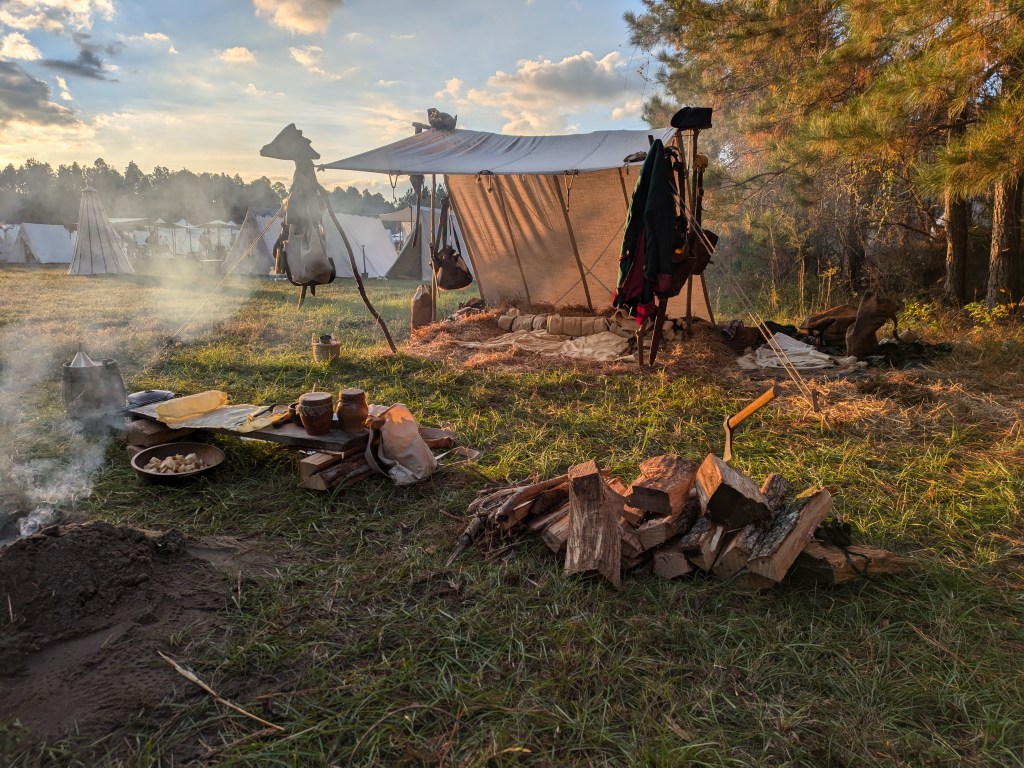
Despite striving to maintain historical authenticity beyond reproach, a historically accurate campaign camp for the 2nd Anspach-Bayreuth Jäger Company (or lack thereof) does not make for an engaging display for the public to visit. For that reason, we have taken the liberty to create a camp that would have been heavier than a typical camp while on campaign; however, it provides our unit a nice display for the public to visit and learn more about the history and role Germanic forces played in the AWI. The modifications to the camp includes: A hand-sewn replica of an 18th century sail, in which we use as a small shelter, and a flat board used for preparing meals. The heavier items are not out of the realm of possibility of a Jäger unit to have (although not explicitly documented in primary sources); however, they are light enough to adhere to Ewald’s observations of carrying only the amount one can carry upon their back. For private events or weekends that the public is not present, we relinquish our heavy luxuries and set up camp according to the standards set by Ewald.
Although the life of the Jäger might seem unpleasant, once used to it we do not dislike this hard way of living…
 2nd Anspach-Bayreuth Jäger Company