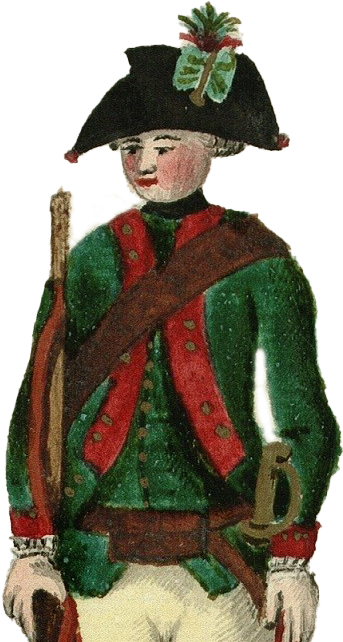
“This Corps… is by no means composed like the infantry of the lowest of people. It is drawn from those employed by hunting and in the forests, in Germany a well esteemed class, and forms by consequence what one calls a corps of distinction.”
— General Schlieffen response to Lord Suffolk, The Hessians, Atwood, pg. 133
The Jägerkorps, who came to fight alongside the British during the American War of Independence (AWI), garnered a distinctive reputation. Unlike most soldiers in the 18th century, Jäger came from a prestigious class in Germanic society. This “well-esteemed class,” comprised of huntsmen and foresters, was coaxed to join the British in the AWI with extra pay and bounties, as their skills in fieldcraft and marksmanship obtained within their civilian trade were highly sought-after for service in America.1 Jäger performance in battle in the first British campaigns, such as the Battle of Long Island and the Battle of White Plains, further reinforced their reputation, which garnered praise from British officers:
“Nothing could behave better than the Hessians, and particularly their Jäger, or riflemen, who are much superior to those of the rebels as it is possible to imagine.”
— J.K. Laughton, The Journal of Henry Duncan, pg. 125
However, as the AWI continued the quality seems to have diminished as the original Jägerkorps began to take casualties and receive replacements. Unrelenting praise transformed into complaints, as Ewald laments his recruits who arrived in the summer of 1777:
“consisted of deserters and insolent rabble, where at blood turned to water and all spirits sank in all of us of the old staff, who until now had commanded the most upright and obedient of men.”
— Johann Ewald, Diary of the American War: A Hessian Journal, pg. 68
The quality of the recruits may have translated into poor performance in the field as in November 1777, a Jäger picket was surprised and beaten by enemy forces under Marquis de Lafayette. Jäger Captain Wreden accounted for such losses because the Jäger at the picket were inexperienced at maneuvering and did not load quickly enough in action.2 Furthermore, Jäger Lieutenant Feilitizch, serving under the combined Jägerkorps (Hessian & Anspach-Bayreuth) noted that enemy patrols were able to surprise and route a Jäger picket because the NCO on duty was drunk.3
Nonetheless, the quality of the Jäger officer remained high because the Jägerkorps developed a command/field rotation, allowing junior officers to gain experience in combat leadership. Regardless of the inconsistent quality of recruits, Jäger still provided exceptional services, as noted by Lord Cornwallis in a letter to Captain Ewald upon his 1777 return to England:
“Sir, I cannot leave this country without desiring you to accept my best thanks for your good services during the two campaigns in which I have had the honour to command the Hessian [Jäger]. If the War should continue, I hope we shall again serve together. If we should be separated I shall ever remember the distinguished merit and Ability’s of Captain Ewald.“
— Lord Cornwallis to Ewald, Diary of the American War: A Hessian Journal, pg. 110
Thus, Jäger, during the AWI, left a legacy that paved the way for further advancements in light infantry tactics and the use of skirmishers on the battlefield. Although the quality of Jäger seemed to have diminished as the war waged on, their unique skills and high-quality leadership overshadowed any shortcomings the Jäger might have had. Therefore, it becomes essential for any living historian or reenactor to honor the legacy of Jäger by continuing the image of a “Corps of Distinction”, by positively contributing to the reenactment and historical community.
 2nd Anspach-Bayreuth Jäger Company