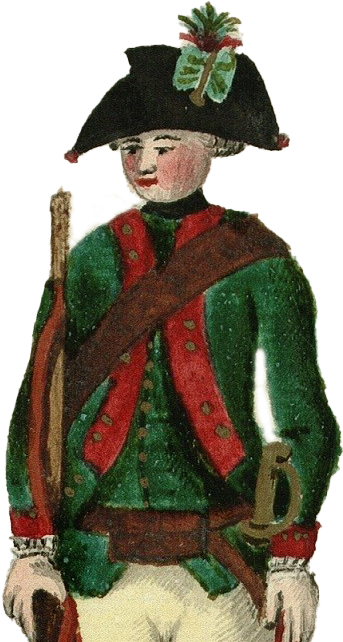

Camp followers, distaff, and soldiers’ wives were indispensable in the infrastructure of armies on campaign during the American War of Independence (AWI). Jäger Companies did not differ from their British counterparts, as there are also records (albeit few) of non-combatant retainers attached to the 2nd Anspach-Bayreuth Jäger Company. Most prominently, evidence of wives that tagged along from Germany can be found in Rev. G.C. Coester’s baptism and marriage records, who was attached as a Chaplin of two Hessian Regiments:
“… Philip Adam — Legitimate son of Christian Conrad Rummel, Field Jäger in Anspach service, born in Anspach and in Captain von Röder’s Company, and his wife, Margaretha Barbara Rinks, also born in Anspach, was born at Flushing on Long Island on 18 January 1781 and baptized by me on the twentieth of the same month and year…”
— Rev. G.C. Coester, Enemy Views: The American Revolutionary War as Recorded by the Hessian Participants, Burgoyne, pg. 569
Additionally, ship logs indicate the presence of women upon departure to and from the colonies where the Anspach Bayreuth contingent of two infantry regiments and “a Jäger company numbered 60 officers, eleven sergeants, 1,271 men and 62 women when it boarded ships at Dordrecht in Holland on 2 April 1777. Embarked to return to Germany on 4 August 1783 there were 1,136 men and women, and 54 children. The women received a half ration while aboard the ship and children were allowed a quarter ration, but neither wives nor children received rum.”1 However, the women that followed Jäger were not limited to ones that came from Germany, as numerous accounts from Coester’s records detail marriages that were conducted while on campaign:
“On 15 September 1777, I married the Hessian Jäger Conrad Sackert of Major von Prueschenk’s Company and Carolina Wetzler of Sebbeterode. This took place in the camp not far from Dilworth in Pennsylvania… Six days later the woman was chased out of camp for being a prostitute.“
— Rev. G.C. Coester, Enemy Views: The American Revolutionary War as Recorded by the Hessian Participants, Burgoyne, 563
Unfortunately, not much else is known about the women who served with Jäger Companies during the AWI beyond records of their names in birth, marriage, and baptism records. There are brief mentions of Germanic camp followers, most famously an account of a Brunswick camp follower following the surrender of Burgoyne’s Army in 1777:
” These Troops had some Women, who wore short Petty coats, bare footed, & bare Leged, with huge Packs on their backs, some carrying a child & leading an other or two, They were silent, civil, and looked quite subdued.”
— Daniel Granger, Documents – A Boy Soldier Under Washington: The Memoir of Daniel Granger, pg. 547
This account, illustrated by Don Troaini, depicts a camp follower in dire circumstances, as the capture and forced march generated hardship that does not necessarily portray the “everyday” circumstances of camp followers of Germanic units. The best details of the clothing of Germanic camp followers come from Baroness von Riedesel, the wife of a Brunswick officer. Upon her arrival to America in 1777, she noted that:
“The ladies were astonished at seeing me dressed like an English woman; for having seen our soldier wives arrived dressed in waist-coats, short cloaks, and round caps with fleppe; they supposed that this was the German dress.”
— Baroness von Riedesel, Baroness von Riedesel and the American Revolution, Brown, pg. 33
The descriptions of clothing worn by Germanic camp followers are helpful for the reenactor; however, one has to consider that these are explicitly not of camp followers of Jäger Companies, specifically one serving in the Southern Campaign of the AWI. More research needs to be conducted to ensure the accuracy of standards to faithfully represent the industrious women who supported the 2nd Anspach-Bayreuth Jäger Company. We humbly encourage all to share any relevant information on this topic so we can diligently create a helpful guide to the clothing and equipment for a 2nd Anspach-Bayreuth Jäger Company camp follower. Our unit currently recognizes that any impression of a lower to middling woman of the late 18th century is sufficient for our standards. Nonetheless, there is fantastic research on camp followers of other units already available, and if one would like to learn more, here are some great sources to start with:
- Brandon Fisichella – Regimental Wives: Women in an 18th Century Army
- John U. Rees – “Some in rags and some in jags,’ but none ‘in velvet gowns.”: Insights on Clothing Worn by Female Followers of the Armies During the American War for Independence
- Bruce Burgoyne – Women with the Hessian Auxiliaries during the American Revolutionary War (Part 1)
- Bruce Burgoyne – Women with the Hessian Auxiliaries during the American Revolutionary War (Part 2)
- Don N. Hagist – Notes on German Army Women
- They Also Served, Burgoyne, pg. 8-9 ↩︎
 2nd Anspach-Bayreuth Jäger Company