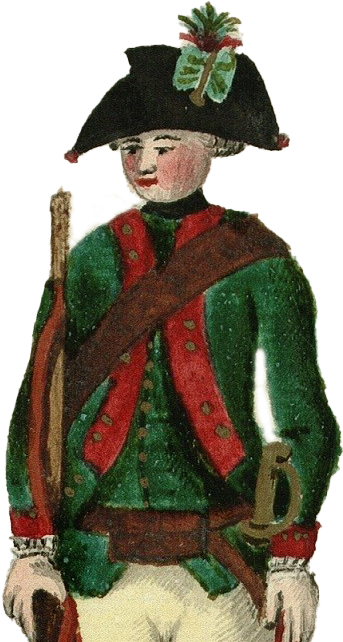
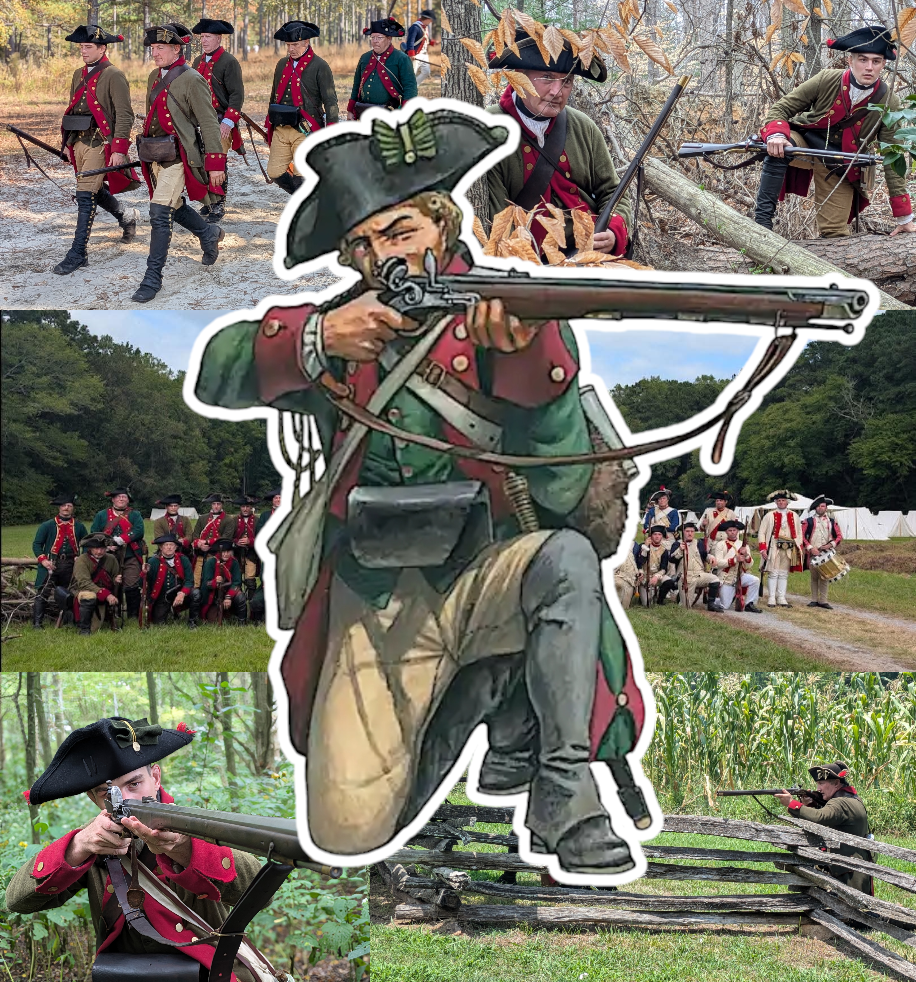
About our Unit:
Jäger Company von Röder strives to accurately portray Jäger and retainers of Capt. Röder’s combined command of 114 Anspach and Hessian Jäger during the 1779-1781 Southern Campaign of the American War of Independence. Current membership is concentrated in the Southeastern United States, geographically close to the area the Jäger Company historically would have operated in. The group is bound by mutual comradery and the personal enjoyment of period encampments, weaponry, and continued historical research. Our unit conducts Manual of Arms and commands in German in addition to following the standards of the Brigade of the American Revolution (BAR) and the British Brigade (BB) as active members.
We invite reenactors, both new and seasoned veterans, to Contact Us and learn more about joining our unit.
History of the 2nd Anspach-Bayreuth Jäger Company
The English Army Colonel William Faucitt was sent to contract units from the Germanic States for service in North America at the onset of the rebellion in the English colonies. During his second trip in February 1777, a treaty was concluded with the Margrave of Anspach-Bayreuth for two Infantry Regiments of five companies each, a 101-man Jäger Company, and a 44-man artillery complement. These units arrived in New York during the summer of 1777.
During the course of the war, five companies joined the original Anspach-Bayreuth Jäger Company. Captain Friedrich Wilhelm von Röder commanded the 2nd Company starting in 1779, which coincided with the arrival of an additional 4,000 Anspach troops in New York. Each Jäger Company that was created was consolidated into the combined Hessian and Anspach Jäger Corps, formed in 1777 under the command of Col. Ludwig Johann Adolph von Wurmb.
In 1780, Anspach Jäger, as part of the Hessian and Anspach Jäger Battalion under Major Wurmb, participated in the 1780 Siege of Charleston; however, despite Anspach Jäger being present, there is no indication that Capt. Röder and the 2nd Company participated in the siege. After the completion of the victorious siege in May 1780, several units, including the Jäger Battalion, sailed back to New York arriving in June of 1780. Capt. Röder appears to have been active in the New York area in June 1780, as a dairy mentions an engagement that the Jäger took losses. It unfortunately notes:
“From our Jäger, Captain von Röder Lieutenant von Diemar were fatally wounded.”
— Johan C. Dohla, A Hessian Diary of the American Revolution, translated by Bruce E. Burgoyne, pg. 132
Fortunately for Capt. Röder, it seems he survived his wounds as in October 1780, he took command of a 100 man Jäger Company (25 Hessians; 75 Anspach) as part of General Leslie’s Southern Expedition.
The combined Jäger Company, as part of the Southern Expedition Forces, conducted raids in the Norfolk, Virginia area, until eventually re-embarking and joining Lord Cornwallis’ army in Charleston, South Carolina in January 1781. As part of Leslie’s Corps, Capt. Röder’s detachment accompanied Lord Cornwallis through the North Carolina campaign, participating in the famous “Race to the Dan”, pursuing General Greene’s forces across the state of North Carolina. The pursuit ultimately led to engagements at Weitzel’s Mill and the Battle of Guilford Court House, in which Capt. Röder and his Jäger were present.
Following the Battle of Guilford Court House, the Jäger Company accompanied the main army of Cornwallis to Cross Creek, during which there was an engagement involving the Jäger:
“26 March 1781… As the Deep river was in flood with heavy rains, a halt had to be made, and we took three rebels prisoners there. The same evening the jäger camp was attacked by 60 rebel mounted militia, who took three jägers at the out post prisoners.”
— Journal of the Honourable Regiment von Bose, pg. 50
Capt. Röder eventually reached Wilmington, North Carolina and the Jäger Company was detached to bolster the garrison located in Wilmington. They stayed in Wilmington until the garrison was relocated to Charleston, South Carolina in November 1781. They remained with General Leslie in Charleston until the garrison’s evacuation in December 1782.
Interestingly, in October 1781, a detached force under the command of Lieutenant von der Heydte, which included Jäger, was sent from either Wilmington or Charleston to aid Cornwallis’ Army in Yorktown; however, they were unable to reach Cornwallis prior to the surrender of Yorktown in October 1781.
“At Night on 19 October, First Lieutenant Moritz Wilhelm von der Heydte, of our Jäger corps, joined us as prisoners of war, with sixteen Jäger. This officer had been detached from Charleston, South Carolina, with a strong Command of about one thousand men in order to join us; however, on the night of 18 October, between Hampton Roads and Williamsburg they were attacked by a strong corps of French and Americans defeated and completely scattered.”
— Johan C. Dohla, A Hessian Diary of the American Revolution, translated by Bruce E. Burgoyne, pg. 179
Based on muster rolls and a passage from Johann Döhla’s diary, our belief is that the detachment of Jäger sent to aid Cornwallis was captured at sea by a French warship and was kept on board until the surrender at Yorktown. It is unknown if Capt. Röder was included in this Jäger detachment.
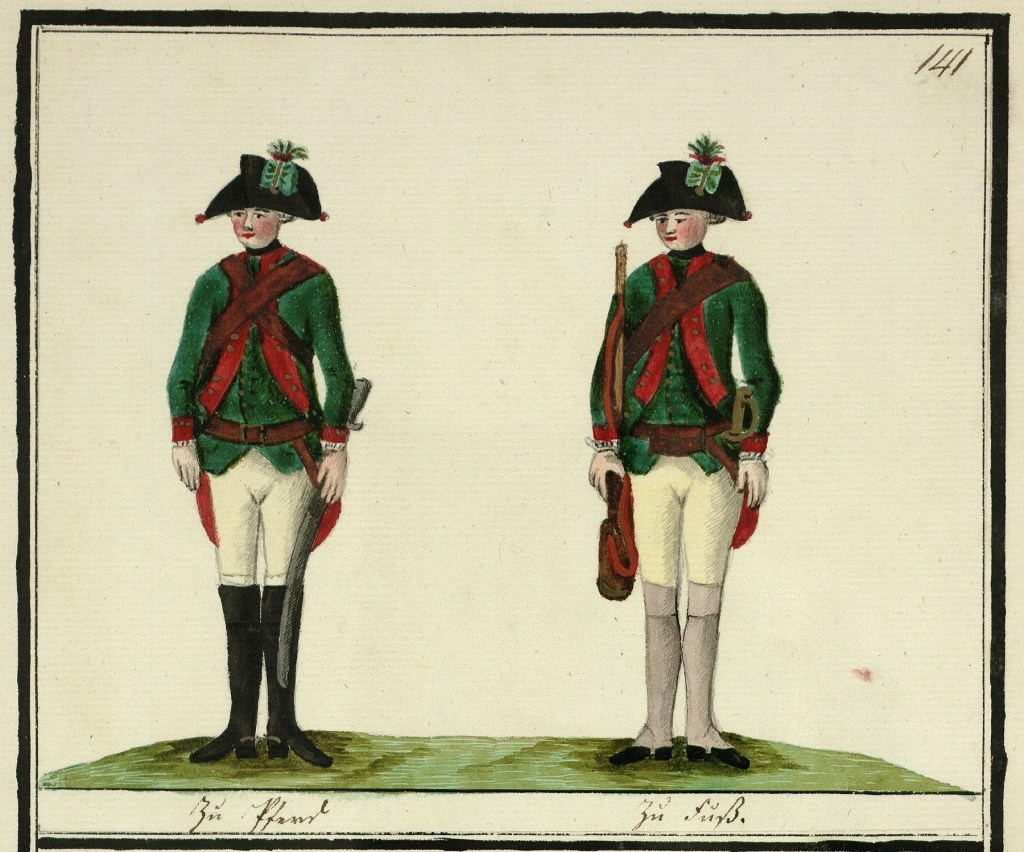
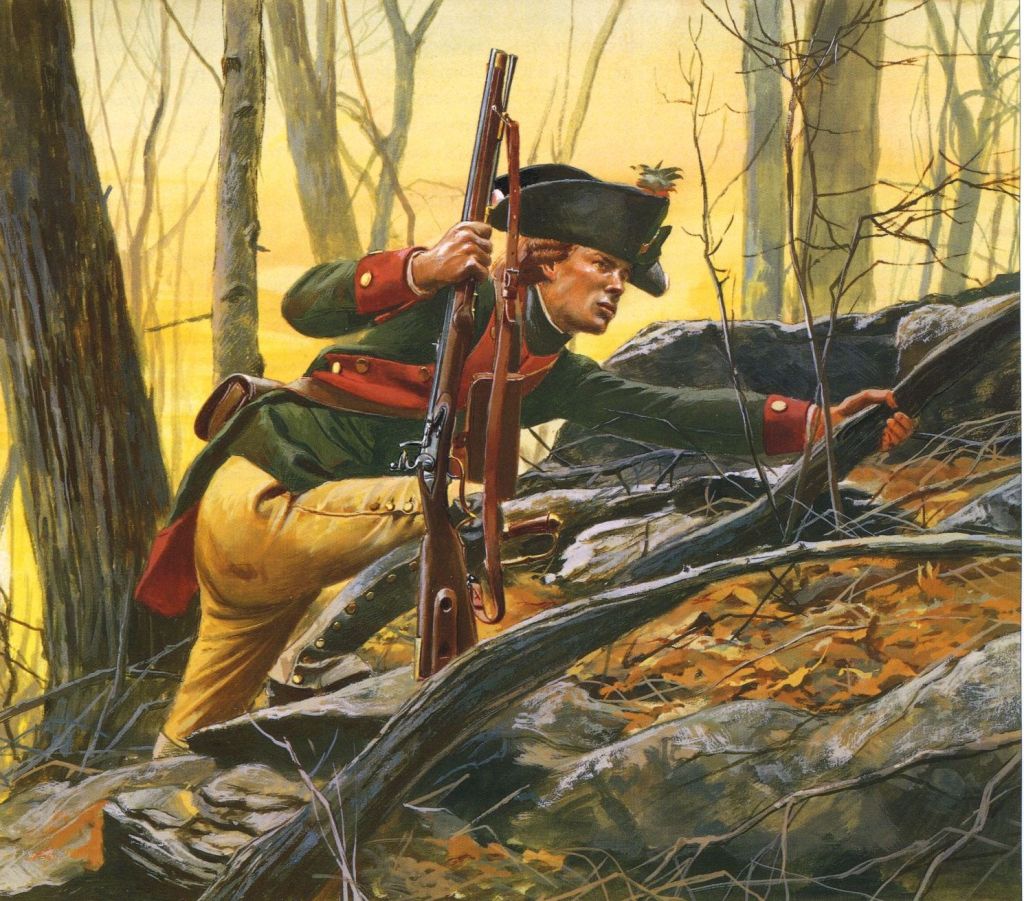

 2nd Anspach-Bayreuth Jäger Company