
Our research primarily focuses on the Jäger, but what about the women who followed the Anspach-Bayreuth troops to America?
When the Anspach-Bayreuth contingent embarked in the spring of 1777, around 60 women sailed with roughly 1,340 officers and men.1 Once they arrived in the colonies, the infantry regiments took the field, but nearly all of their women were left behind in New York.2 General Leslie’s embarkation orders of 12 September 1780 allowed “Four Women Pr 50 Men”,3 but no primary documentation lists a woman with Captain Röder’s detachment in Virginia or the Carolinas. Ewald, who commanded Hessian and Anspach Jäger together on numerous occasions, later wrote that the light troops often spent entire campaigns “ohne Weiber”, or without women, and learned from the English to wash their own shirts and stockings.4
Fortunately, some documentation exists of the women of the 2nd A-B Jäger Company, all of whom are strictly attached to the main body of the Company around New York. Margaretha Barbara Rummel, whose husband is recorded as a Jäger in Captain Röder’s Company, gave birth to a son in Flushing, Long Island, on 18 January 1781;5 Wilhelmina Neff, wife of Jäger Johann Neff, also gave birth in camp north of New York on 20 September 1782.6 Margarethe Popp gave birth to a son on 9 November 1783 during the march home through the territory of Fulda, so we assume she had been with her husband in America. The widow of Corporal Hartwig, wounded near Kingsbridge in July 1781 and died in November, came home from America and was granted 15 florins, two cords of wood, and a measure of grain each year.7 Unfortunately, her name was never recorded.
The supply lists that guide us for the Jäger offer little description of these women’s clothing, as women’s clothing was never issued. No official Anspach document describes what a soldier’s wife wore; however, we can glean some details from the British army the Jäger marched with in the Carolinas, as its orderly book indicates that camp followers’ clothing was closely scrutinized. For example, on 1 March 1781, the Brigade of Guards ordered every article of clothing belonging to its women to be listed by the pay sergeants, and anything added later that had not been “fairly purchas’d” was to be “Burnt at the Head of the Company”.8
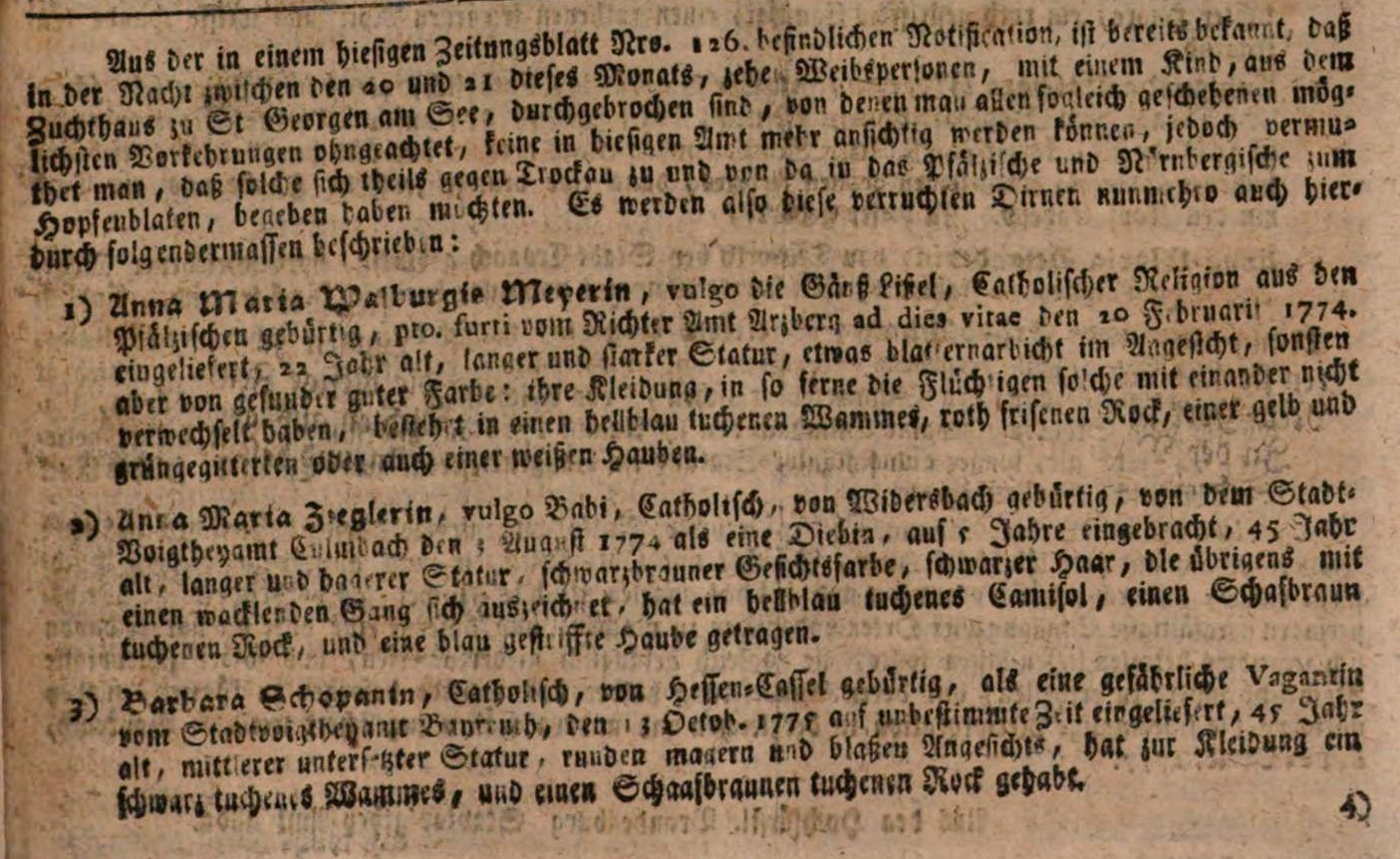
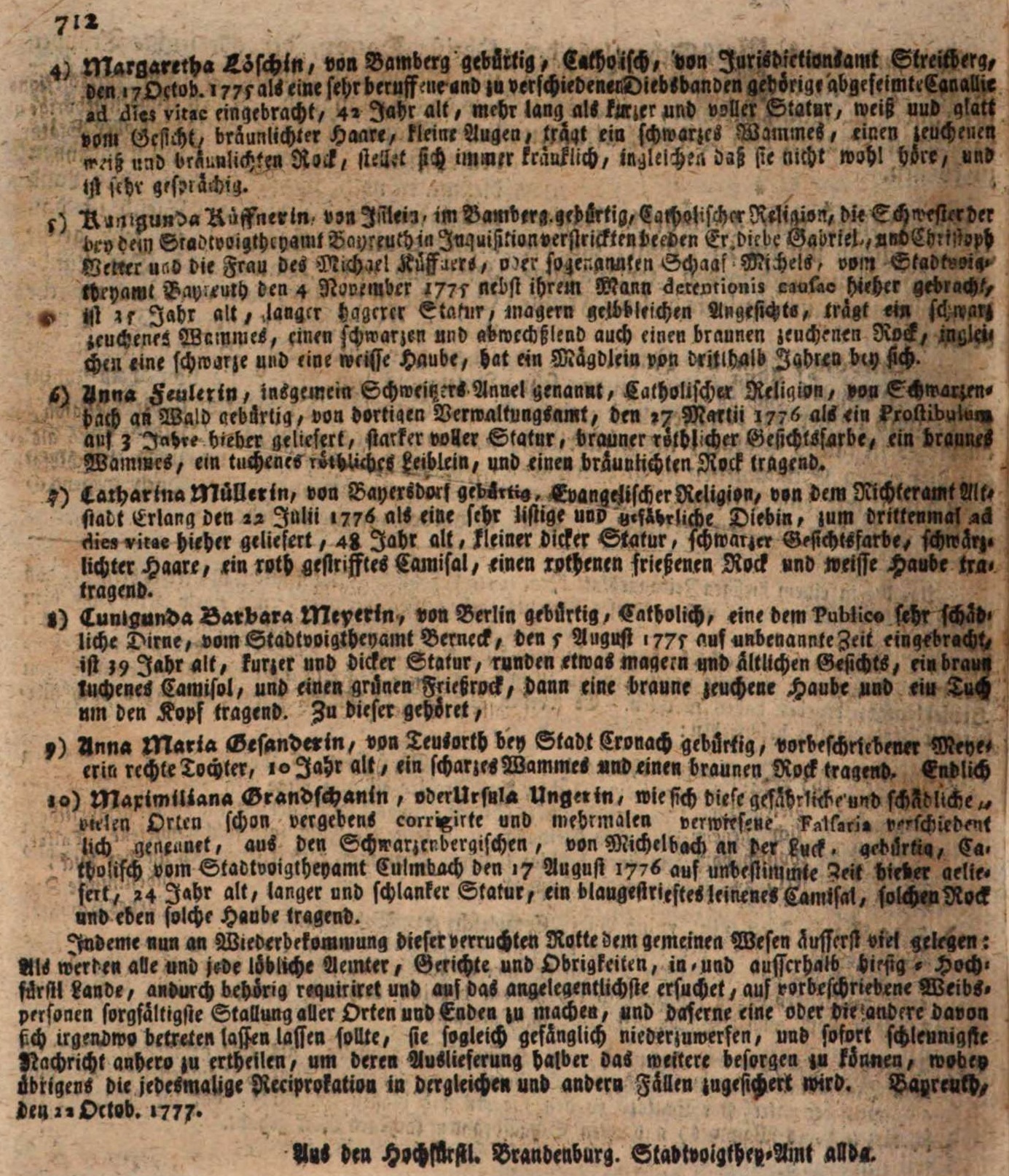
Our best analog comes from home. A notice dated 21 October 1777 in the Bayreuther Zeitungen describes ten women who had escaped from the “Zuchthaus”, or workhouse, at St. Georgen during the night and offers a description of each based on their clothing. Nearly every woman wore a “Wammes” or “Camisol”, a short jacket, of light blue, black, or brown cloth, black worsted, or striped linen, over a “Rock”, or petticoat, of red or green frieze or of “Schafbraun” (sheep’s-brown) cloth, which we interpret as the natural brown of undyed wool. Their “Hauben”, or caps, were white, black, brown, blue-striped, or checked in yellow and green, and one woman wore “ein Tuch um den Kopf”, a kerchief around her head.9 Of course, these women were prisoners and not soldiers’ wives, so we use the notice only as a comparison for what ordinary women of the principality wore in the year the regiments left home.
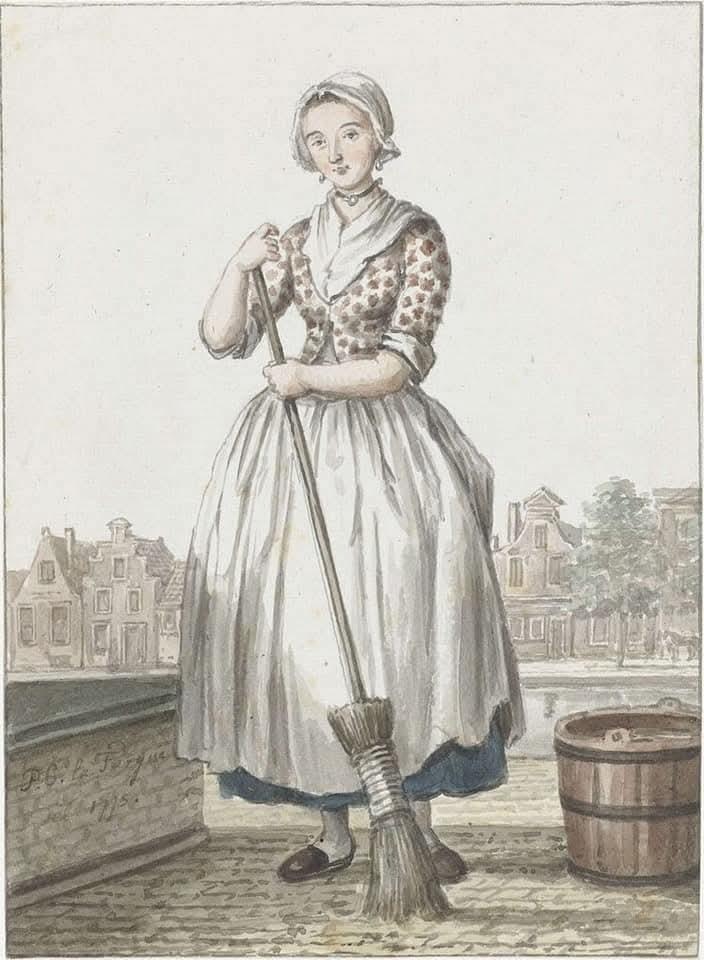
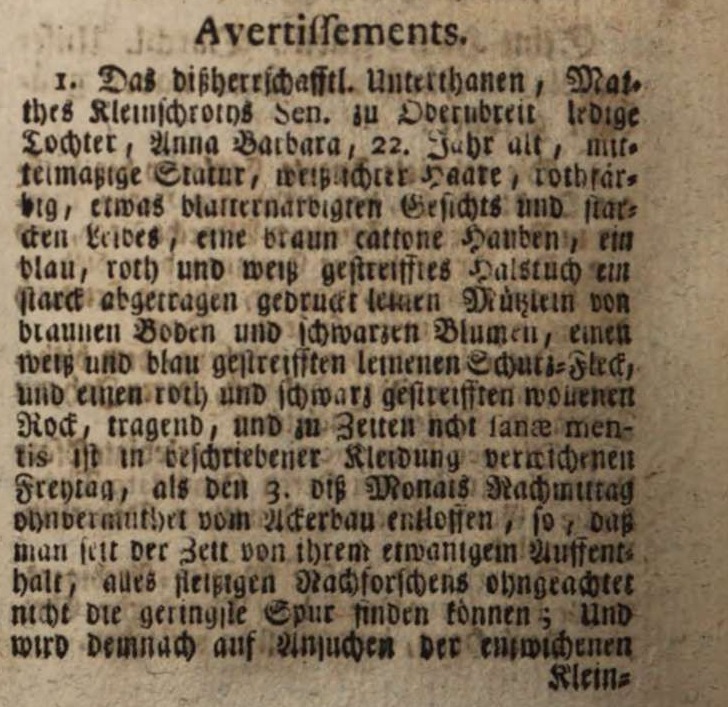
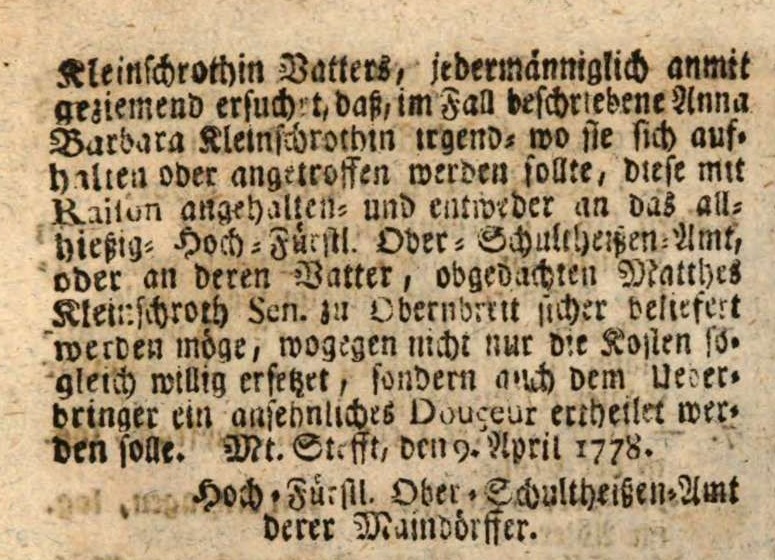
A second notice in the Ansbach weekly paper describes a countrywoman of the principality the following spring. On 9 April 1778, the Ober-Schultheißen-Amt of the Main villages at Marktsteft sought Anna Barbara Kleinschroth, the 22-year-old unmarried daughter of Matthes Kleinschroth of Obernbreit, who had run off from the field work on 3 April. She wore “eine braun cattone Hauben, ein blau, roth und weiß gestreifftes Halstuch, ein starck abgetragen gedruckt leinen Mützlein von braunen Boden und schwarzen Blumen, einen weiß und blau gestreifften leinenen Schurz-Fleck, und einen roth und schwarz gestreifften wollenen Rock”, or a brown calico cap, a blue, red and white striped handkerchief, a much-worn short jacket of printed linen with a brown background and black flowers, a white and blue striped linen apron, and a red and black striped woollen petticoat.10 Unlike the women of the workhouse, she was not a prisoner but a young woman at work in the fields, so her outfit is a good comparison for what an ordinary countrywoman of the principality wore while the regiments were in America.
Although we cannot yet say for certain what any woman of the 2nd Company wore, we are thankful for every minor detail that brings us closer. As we work to represent the women of the Company as carefully as the Jäger, we welcome any and all feedback.
- A Hessian Diary of the American Revolution, Döhla, translated by Burgoyne, note 15; A Generous and Merciful Enemy, Krebs, pg. 73 ↩︎
- Tagebuch eines Bayreuther Soldaten, Döhla, pg. 128 ↩︎
- “A British Orderly Book, 1780–1781”, edited by A. R. Newsome, North Carolina Historical Review 9 (1932), pg. 71 ↩︎
- Abhandlung von dem Dienst der leichten Truppen, Ewald (1790), pg. 39 ↩︎
- Register of the Hessian chaplain Coester, in Enemy Views, Burgoyne, pg. 569 ↩︎
- “Women with Hessian Military Units”, Burgoyne, Brigade Dispatch 26, no. 3 (1996), pg. 2 ↩︎
- Die Ansbach-Bayreuther Truppen im Amerikanischen Unabhängigkeitskrieg 1777–1783, Städtler, pg. 126 and 143, drawn from the Anspach military church book and pension records; Corporal Hartwig’s wound and death are taken from the company’s muster rolls ↩︎
- “A British Orderly Book, 1780–1781”, edited by A. R. Newsome, North Carolina Historical Review 9 (1932), pg. 378 ↩︎
- Bayreuther Zeitungen, supplement to No. 127, 21 October 1777, pg. 711–712, digitized by the Bayerische Staatsbibliothek ↩︎
- Onolzbachische Wöchentliche Frag- und Anzeigungs-Nachrichten, Num. XV, 15 April 1778, pg. 2–3, digitized by the Bayerische Staatsbibliothek ↩︎

